Hoosier Machine Products' Jeep Conversion Kits

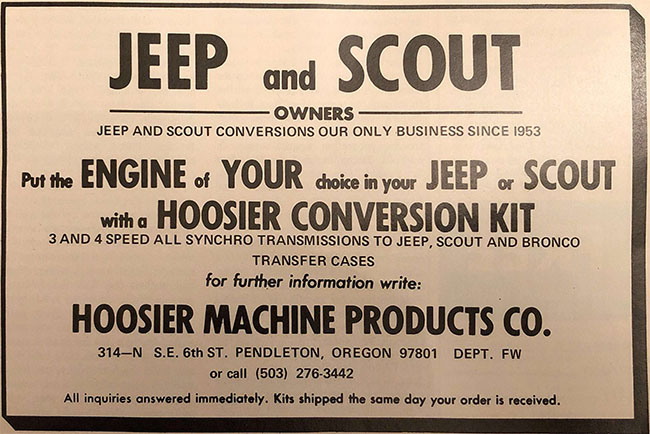
UPDATE: I was surprised to see that Hoosier advertised in Four Wheeler Magazine for several months during 1973 (possibly longer).
Scannable Document

===================

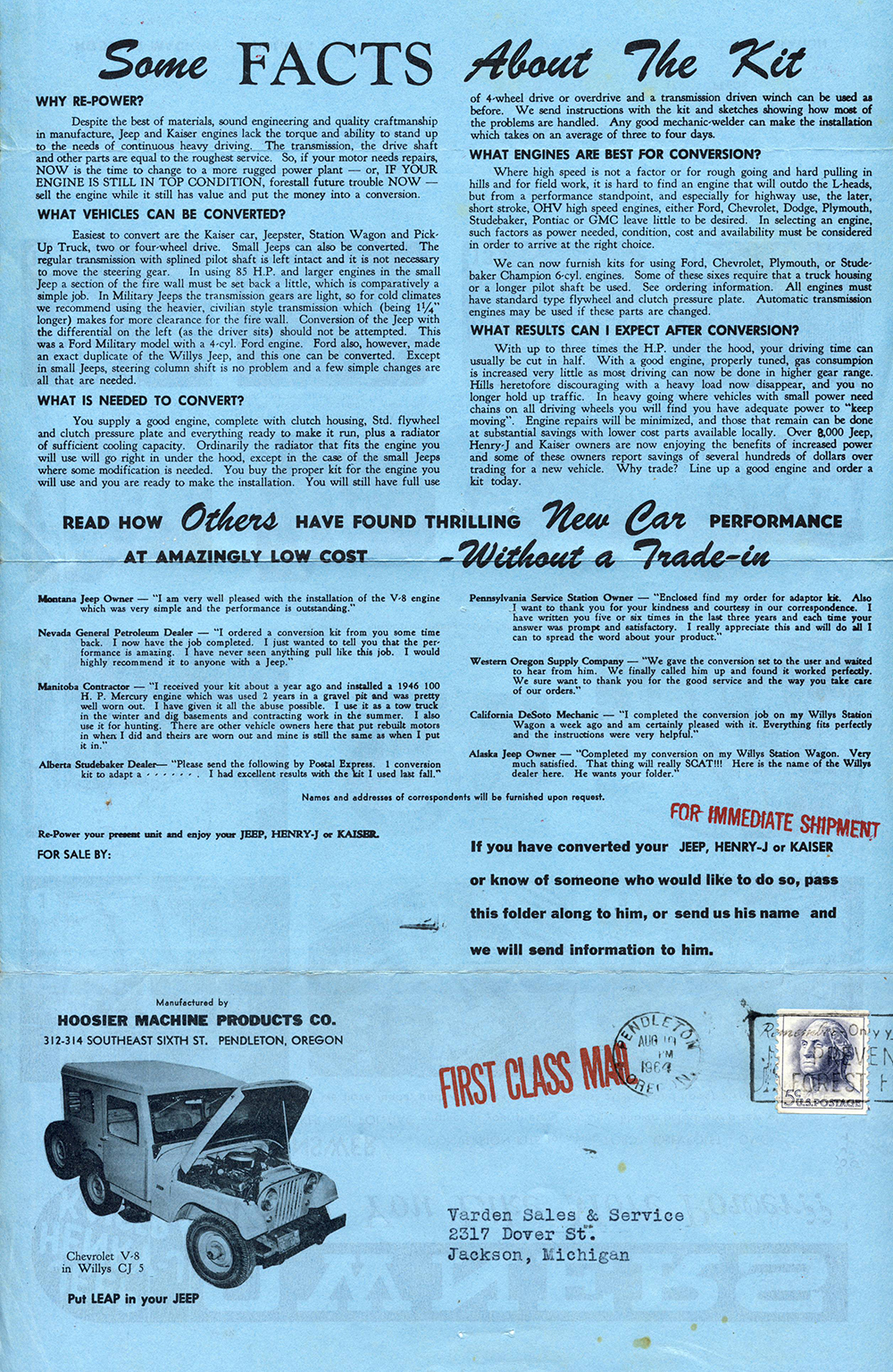
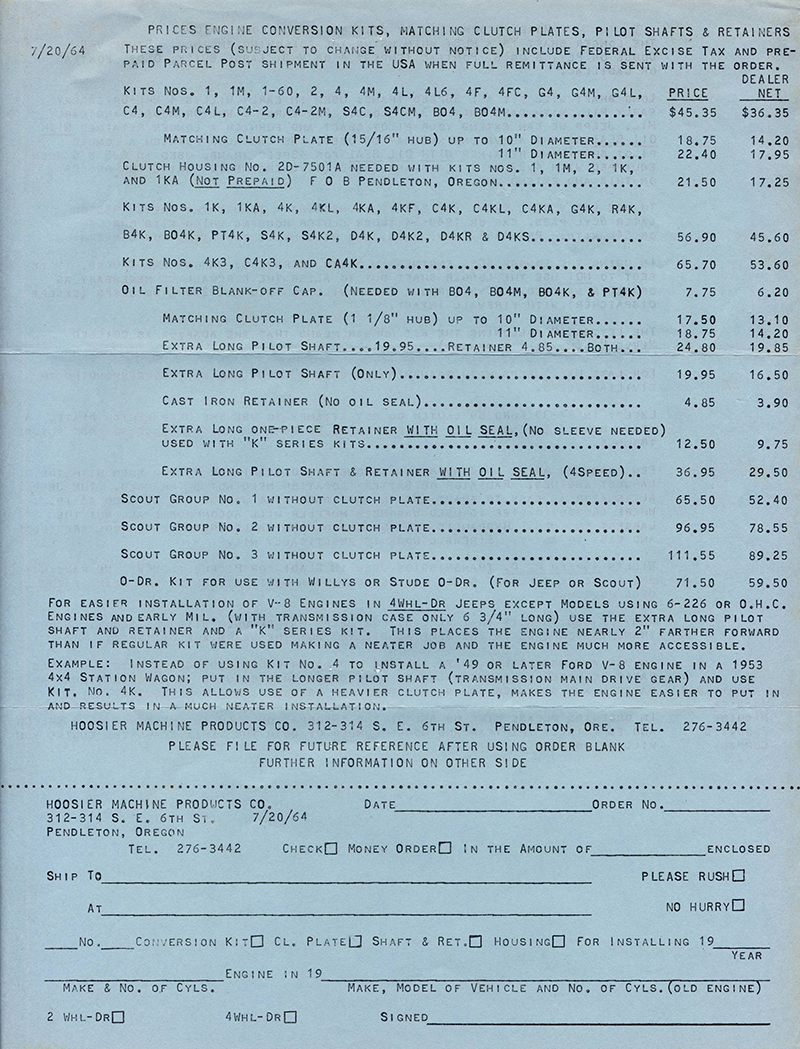
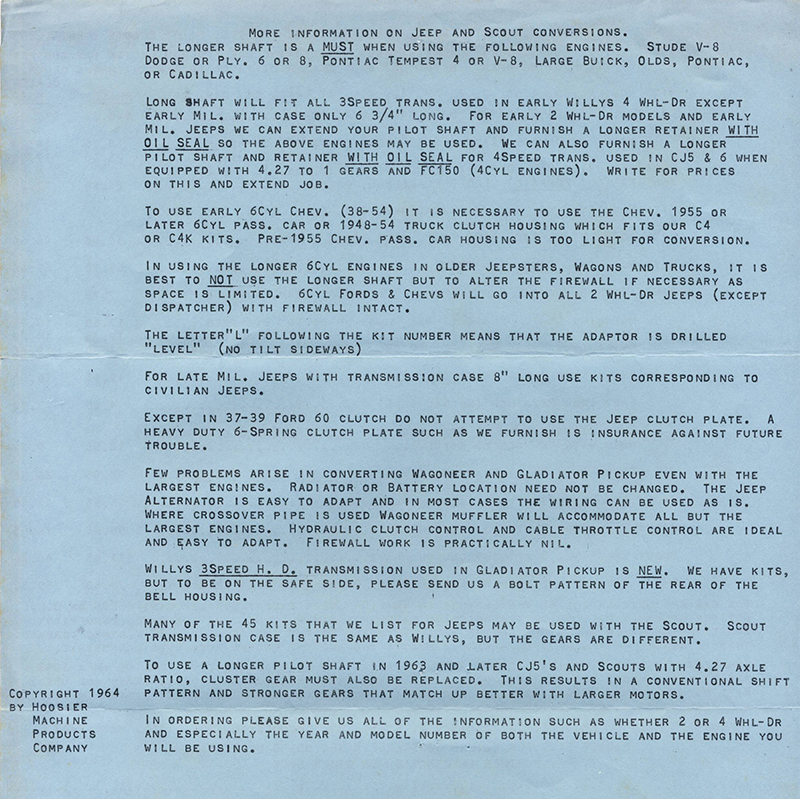
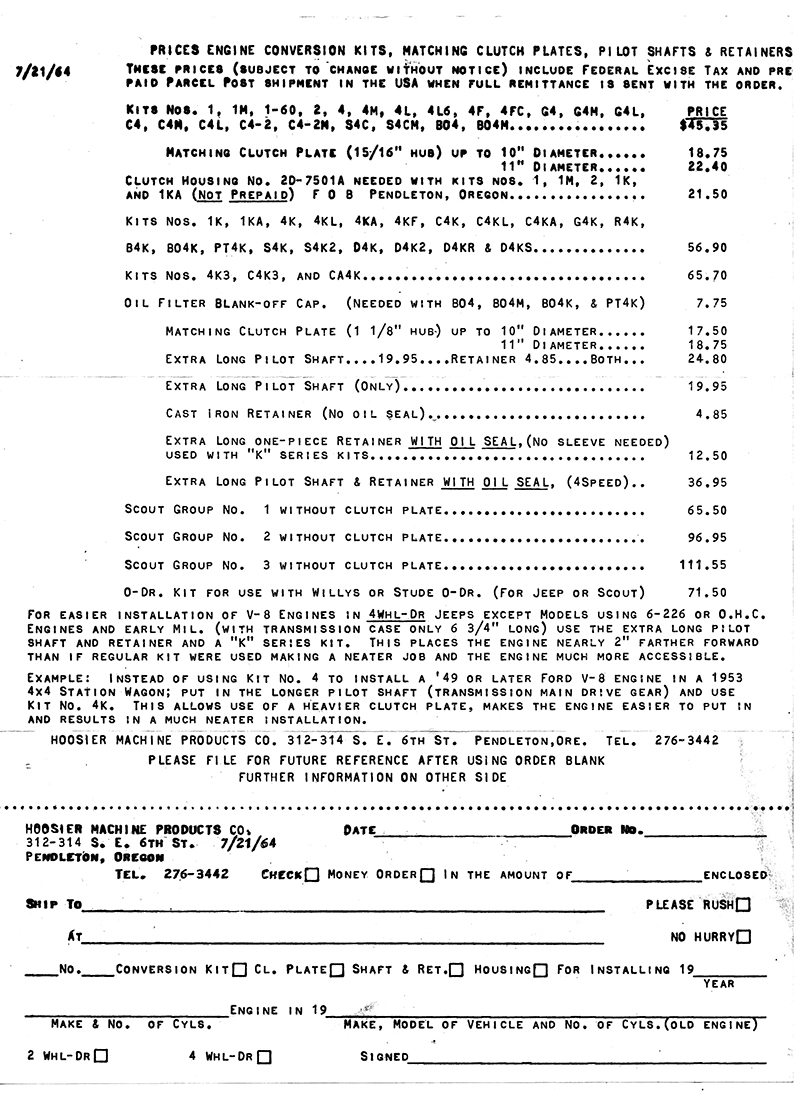
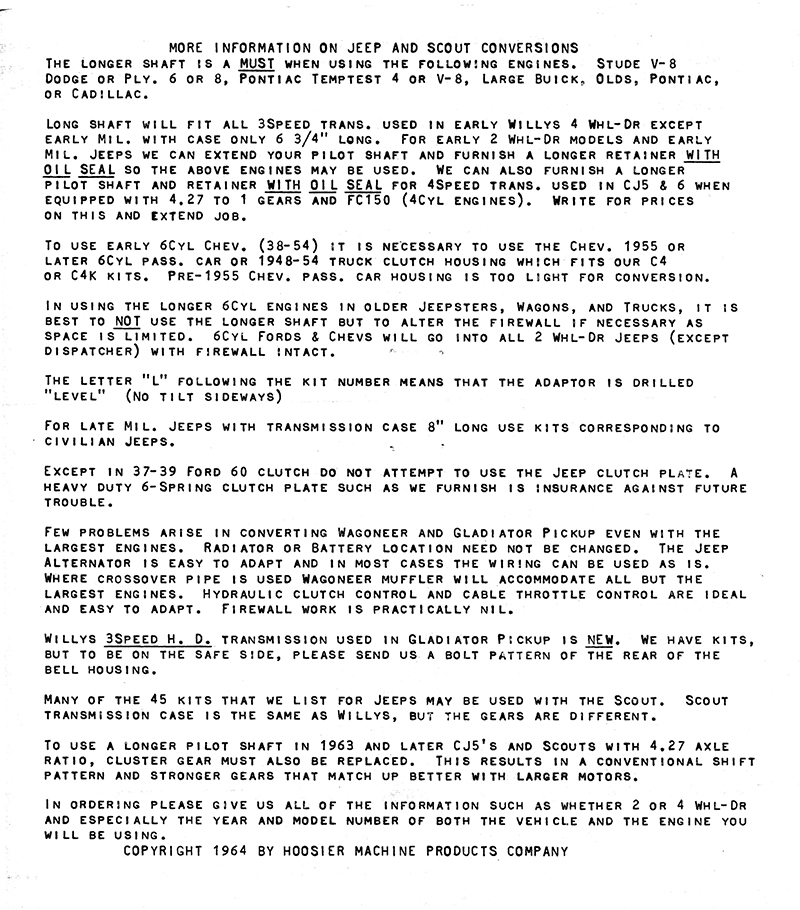
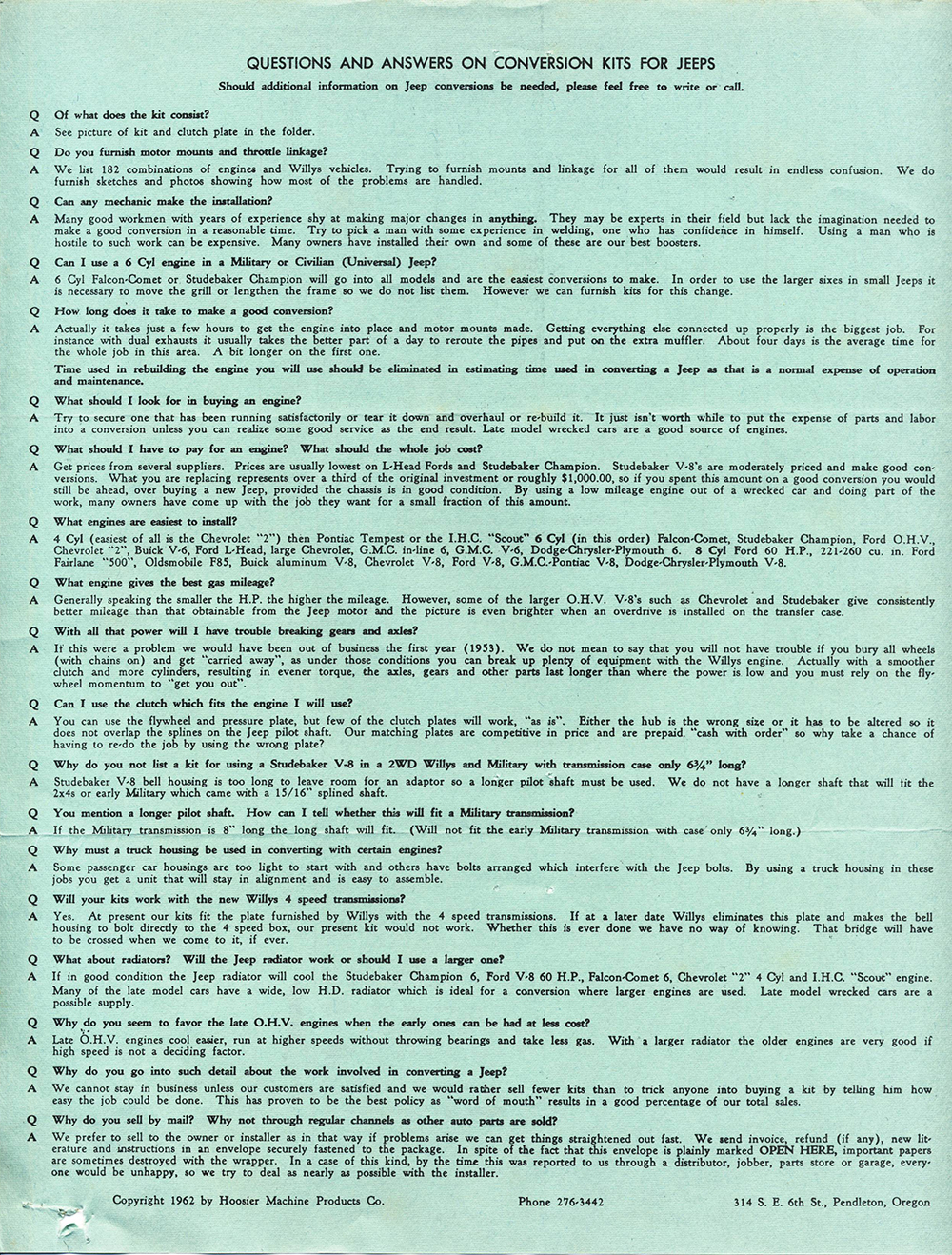
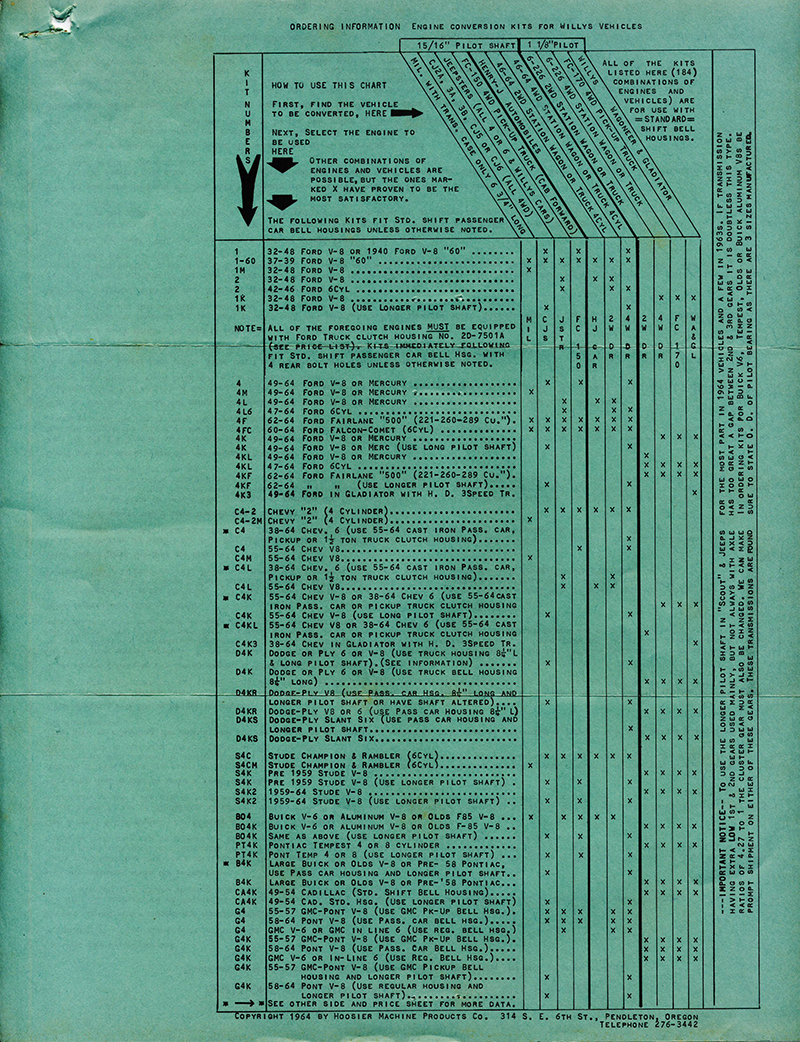
ORIGINALLY PUBLISHED JUNE 6, 2019: In the early 1960s, Hoosier Machine Products out of Pendleton, Oregon, (just an hour south of me) began selling conversion kits for jeeps. The company's kits allowed the repowering of jeeps using Ford, Chef, GMC, Mercury, Dodge, Studebaker and Pontiac engines. That's a pretty impressive, wide range of options, especially for a company out of Pendleton, which was pretty remote at the time. But, given the long distances Pendleton owner's jeeps had to travel to reach other towns and the existence of the nearby, steep Blue Mountains, which provided endless jeeping possibilities, perhaps there was a reason Pendleton jeeps need more power?

Also, a big thanks go to Maury for spotted this brochure for me!
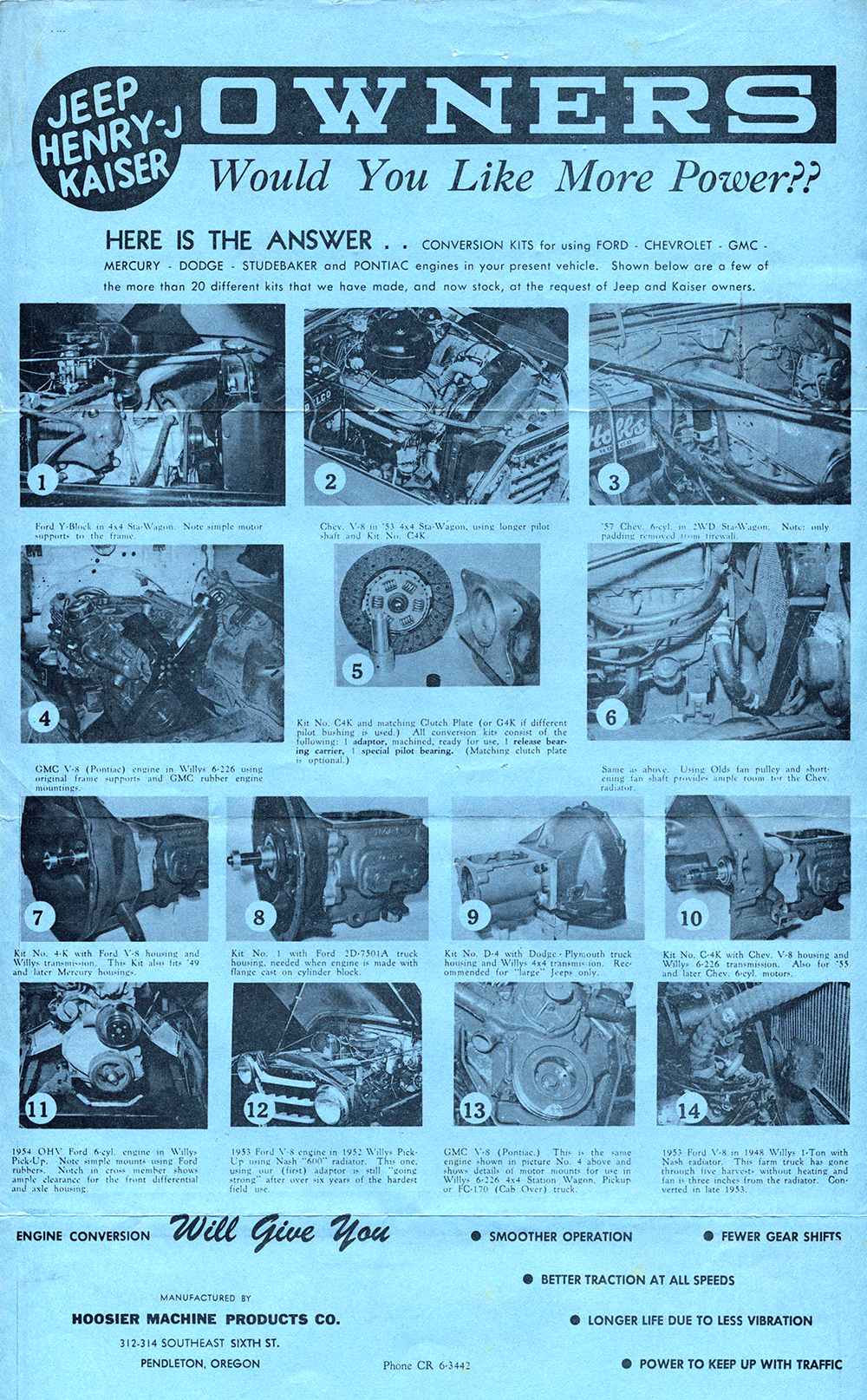
1964-08-18-hoosier-machine-pendleton-brochure1
1964-08-18-hoosier-machine-pendleton-brochure2
1964-08-18-hoosier-machine-pendleton-brochure7
1964-08-18-hoosier-machine-pendleton-brochure8
1964-08-18-hoosier-machine-pendleton-brochure3
1964-08-18-hoosier-machine-pendleton-brochure4
1964-08-18-hoosier-machine-pendleton-brochure5
1964-08-18-hoosier-machine-pendleton-brochure6

8 Comments

  1. Steve Redinger
    I had a Hoosier adapted Ford Toploader behind a Ford 289 in a CJ3a back in the Late 70s. They would weld up the main input shaft and cut splines on it for the T-Case drive gear. I used a three-speed for strength. The Manager and head machinist was named Don Page. I bought several adapters from him during that era. I was living in Walla Walla, Wa about 50 miles from their shop. They also told me how they tested different transmissions-- out on one of the air strips in Pendelton. They ran the transmissions against a Mopar 340, with Dana 44s from a Scout-with lockers and large tires. The Ford Top-loader survived. Back i those days Jeepers had not yet discovered running SM420s and the like. Some had Jeepsters with t-18s though (of course). OK Don Page would also adapt the Top Loader for GMS by machining down the retention ring and extending the trans mounting ears by welding them with Nickle Rod. Don Page's favorite Jeep was named "The Blue Bucket" and he first ran a Chevy II four-cylinder, then later a Capri 2800 V6. On the Capri V6 he built a custom main input shaft-- again welding to maching different splines. I abandoned V8s in old bobbed-tailed Jeeps and ran Buick V6s with heavy flywheels after around 1977. I converted four Cj3a to Buick V6s, and Later a Nissan 720 finally a Cj6. Always did brakes and steering conversions too.
    1. David Eilers
      Hi Steve, I appreciate your additional insight into Hoosier and John Page! If you or Don made it to the summer convention at La Grande (circa 1973?) then I may have even seen you two. I was an 8yo in 73, but that summer convention still stands out. So many clubs and jeeps I had never seen before. I grew up doing Jeep club stuff out of Renton, but now live in Prosser and get to Walla Walla at least once a year (VA visits). I have a few vintage jeeps in my shop, including a Parkette-bodied racer with a Ford Top Loader and built chev 350. Anyway, thanks again for your insights! - Dave d@deilers.com
  2. JohnB
    Dave to follow-up on your 2019 comment and the comment in the brochure (under the "What vehicles can be converted?" section), I wasn't aware Ford made two versions of GPWs. I thought they MB/GPWs were standard..unless he's referring to the 1940 Fords which had slat grilles, slightly different bodies and Ford instrument clusters. Can you elaborate?
  3. David Eilers
    Hi John, You are on the right track. The brochure is referring to the 1941 Ford GPs, which used a left-drop transfercase (FYI the Pygmy arrived for testing in late Nov 1940, but the production GPs did not arrive until March 1941). I am not sure if it was the left-drop style tc that limited its ability to use the Hoosier product or if something else in the design created an issue. It looks like the transmission is offset quite a bit to the right to accommodate the left-drop tc as seen in this pic: https://i0.wp.com/www.curbsideclassic.com/wp-content/uploads/2021/09/xt_GP_dashboard_gp1_gp.jpg?ssl=1 btw, the GPW was supposed to be a copy of the MB, but there are numerous tiny differences, some of which were better than the MB (the stamped grille was a good example, of course later adopted by Willys). The GPW hinged lights were another clever idea, though I have no experience as to the practicality of that design. I hope that helps!
  4. JohnB
    Thanks for the clarification. until recent!y when I got a bit deeper in military Jeeps, I didn't know a lot about the Ford GPs. Whenever I saw a photo of one I wrote it off as a prototype. I didn't realize they made as many as they did. An acquaintance has a couple in here in town, he uses one as a summer daily driver.
  5. David Eilers
    John, Years ago a guy from Indonesia found several for sale there. They didn't make many of them, but those prototypes sure went places! Here's a good source for production numbers for both prototypes and production WWII jeeps: https://wwiijeepparts.com/Archives/JeepSerialNumber.html#WWIISerialNumbers
    1. Roger
      My 46 willy’s cj2a was the last jeep built by Don page in the early 80’s before the closed the shop.
    2. Steve Redinger
      Yes they finally closed the shop in the 80s. Advanced Adapters and Novak continued on. I lived in Logan, Utah when Novak opened shop there. The olden days of engine swaps ended. The demands of urban traffic made it difficult to drive old Jeeps daily very difficult too.

Leave a Reply